FTC Scrutiny Is Broadening. Who's Checking Your Store?
By Nick Letsios, CEO, AI Assist, Inc.What a credible dealer compliance monitoring program needs, the risks of a homegrown one, and how outside and inside records work together.
Read the postNew York City's lawsuit against CarGurus is about deal ratings, fee badges and an AI chatbot. Here is what I'd check in my own store while the case plays out.
I've been in automotive retail since 1991, and I've watched the same vehicle price travel further every year. Today it goes from the DMS into a feed, onto a half dozen listing sites, and into a text message an AI assistant sends at eleven at night. Every handoff is a chance for the conditions behind the price to fall off, and on October 15, New York City announced a lawsuit that puts that problem in front of a judge.
Figure 1
One price, five stages
The City of New York and its Department of Consumer and Worker Protection sued CarGurus on October 5, 2026 in New York State Supreme Court in Manhattan, and announced the case ten days later.12 It's a city case under the city's consumer protection law, and the New York State Attorney General isn't a party.
The complaint makes four main allegations. It says CarGurus rated listings "Great Deal" or "Good Deal" and showed dollar savings against its market value estimate, using asking prices that left out mandatory dealer fees, required down payments or trade-in conditions spelled out in the listing's fine print. It says the "price includes fees" badges CarGurus added this spring overstated what dealers had actually disclosed. It says the company didn't enforce its own rule that listed prices be full cash prices available to anyone. And it says the site's AI chatbot produced lists of "Great Deals" in New York City without the dealer disclaimers or vehicle descriptions attached.2
The complaint alleges thousands of violations involving deal ratings, savings claims and representations about enforcing pricing guidelines. The city wants a court order, civil penalties of up to $3,500 per knowing violation, restitution and costs. The complaint says the city sent CarGurus cease-and-desist letters in 2023 and 2025.2
CarGurus disputes the allegations. CEO Jason Trevisan said the city's claims "don't reflect the facts" and that the company will defend itself vigorously, and CarGurus says it was the first car shopping site to require dealers to disclose mandatory fees on used listings to keep their deal ratings.3 What I describe from the complaint is the city's account of events.
The city's announcement includes an example any desk manager will recognize. A 2018 Honda listed in June 2026 was rated a Great Deal at $2,212 below CarGurus' market value estimate. The city says the listing's disclaimer added $3,685 in required charges, which would put the buyer $1,473 above that estimate.1
Figure 2
The city's Honda example, measured against market value
A feed can copy a price exactly and still pass along an incomplete offer. If mandatory charges sit outside the advertised price, the problem starts before any chatbot answers a question. The first job is to get the advertised price right, and the next is to make sure every listing and every customer response uses it.
The chatbot is the part I'd pay the most attention to. Commissioner Samuel Levine put it plainly to Inc.: "When you're a company that is employing an AI chatbot, you are responsible for the output of that chatbot."4 In a joint statement announced October 1, the agency and two other city agencies said the city's consumer protection law covers representations made by chatbots and other automated systems. The statement didn't create new legal standards.5
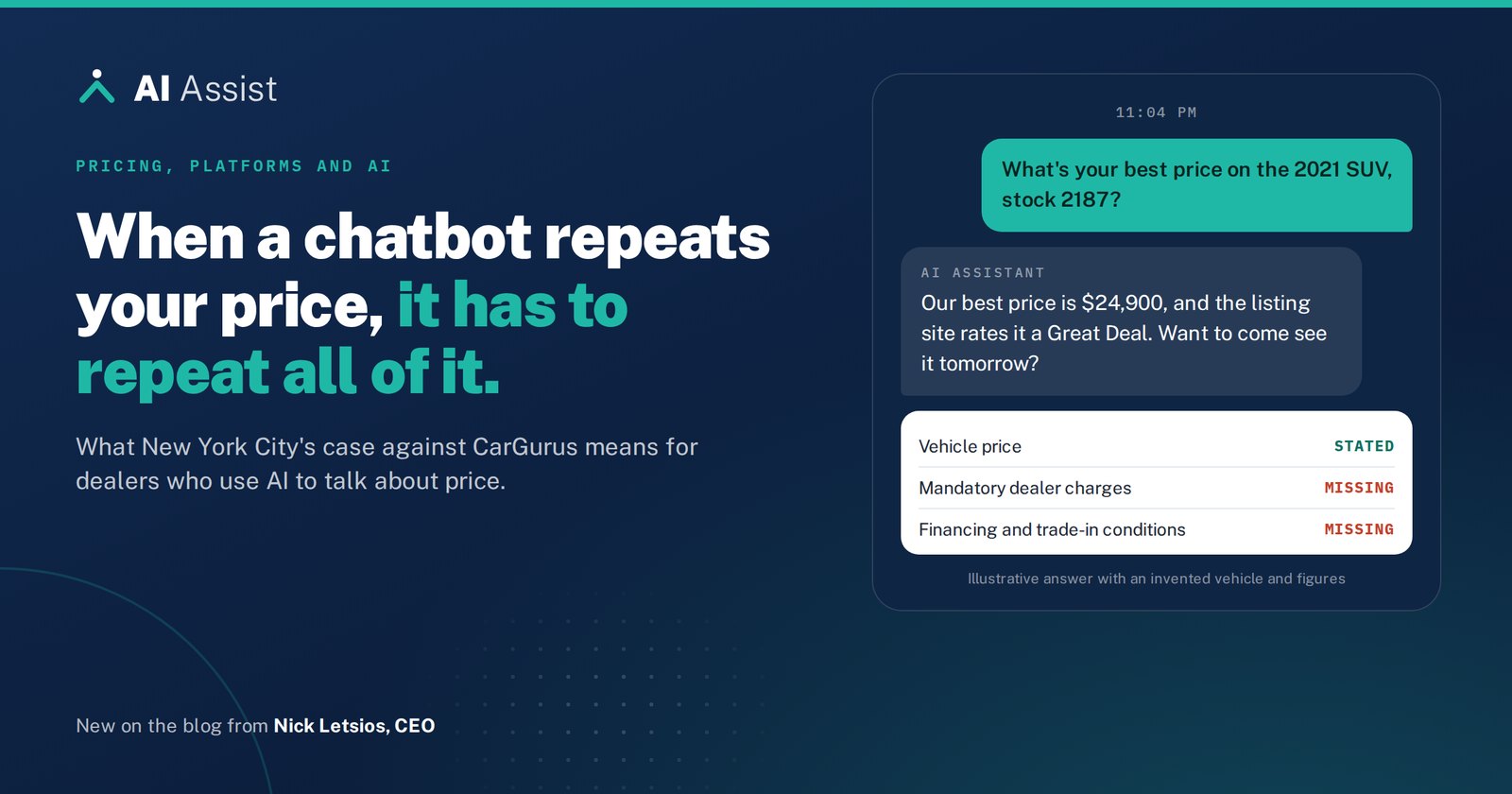
According to the complaint, the chatbot repeated prices and ratings that came straight from the listings, and its answers left out the disclaimers and vehicle descriptions that qualified them.2 Any AI tool a dealer uses can make that mistake, because a short, friendly answer is exactly where a condition gets cut.
Figure 3
Same shopper, same vehicle, two answers
The shopper types, at 11:04 p.m.What's your best price on the 2021 SUV, stock 2187?
Our best price is $24,900, and the listing site rates it a Great Deal. Want to come see it tomorrow?
The price is $26,894, including all mandatory dealer charges. You don't need to finance with us or trade in a vehicle to get that price. Government-required taxes, title and registration charges are additional. Would you like an itemized quote?
AI Assistaiassistinc.com
This lawsuit doesn't move responsibility away from the dealer. In the Lindsay Automotive case, the FTC and the Maryland Attorney General alleged that more than 88 percent of sampled consumers whose vehicles were advertised on CarGurus.com and Cars.com paid more than the advertised price.6 Lindsay's April settlement required a $3.1 million civil penalty payable to Maryland and refunds of qualifying overcharges and add-on fees. The FTC said consumers charged more than $75 million between April 2020 and December 2025 could be eligible for redress.
In March, the FTC sent warning letters to 97 dealer groups about advertised prices.7 In September, FTC staff published pricing FAQs saying the advertised price has to be one any consumer can pay, including on third-party listings, calls and texts, and that everyone who controls the advertising is responsible for it.8 The New York Attorney General announced more than $1 million in refunds from two Westchester dealerships over a fee consumers were led to believe was required.9 And on October 8, the FTC announced a proposed order with Greenway Auto Group in Florida, alleging the group charged more than $3,350 above advertised prices on average in over 92 percent of transactions, and that after its March warning letter it added price transparency claims to its websites while the low prices continued.11
Figure 4
From the dealer's price to the platform's answer, 2023 to 2026
AI Assistaiassistinc.com
That Greenway detail is worth showing your marketing director. Saying you're transparent is a claim like any other, and a regulator will check it against the deals.
For a store that already advertises a complete price, there's a competitive issue here too. An incomplete price can make another dealer look cheaper before the shopper ever talks to your team.8
Compare the same VIN and the same version of the offer on your website, each marketplace, your chat tool, and the first text or email a lead receives. Then ask the desk for a written quote. Set aside taxes, government charges and products the customer chose, and look into any change that's left. Put one manager in charge of resolving what you find, then repeat the shop to confirm the correction reached every channel.
FTC staff guidance says required dealer charges belong in the advertised price. If a disclaimer adds a prep or reconditioning charge to your listed price, put that charge into the price you advertise, then update each marketplace's fee fields to match.
Where does the price in an answer come from, how do the conditions travel with it, and what does the system do when the price or fee data is missing, stale or conflicting? You want to hear that it hands the conversation to a person. Then ask for a log of what the tool told customers last week.
In F&I, price every product on its own line and record the customer's yes or no for each. A quick summary, from a person or from software, can blur whether a product is optional.
Transcripts and timestamps help establish what the customer was told and when, and they show you what to fix when an answer was wrong.
Marina and I built AI Assist around a simple rule: the system advises, and the person decides. Argus360 shops a store the way a customer would, by text, email, web form and, where state law allows, phone, and compares what the shopper was told with the listing, with the transcript and timestamp attached. It's in beta at the founder's store, Atlantic Kia, which Marina and I operate, and general availability is anticipated in Q4 2026.
AiF&I is being designed so the F&I office works from one record of the price, the products and the customer's choices, and staff approves before anything is final. It's prototyped today, and our design partner program opens in December 2026.
What these tools are, and what they aren't
Neither product makes a store compliant, and I'd be careful with anyone who says theirs does. They give you evidence to act on with your managers and counsel.
However the court rules, the question belongs to every dealer. When a listing site, a chatbot or one of your own people repeats your price, do they repeat all of it? I'd find out this month, before a customer or a regulator does.
AI Assist, Inc.
We'll walk you through an Argus360 Report Card and how a finding is documented.
The claims against CarGurus are allegations by the City of New York, and CarGurus denies them. Settled matters described here were resolved without findings of liability unless stated otherwise. This article is for general information and isn't legal advice; whether a specific advertisement, message or contract meets the rules that apply to your store is a question for your counsel. Argus360 and AiF&I are products of AI Assist, Inc.

Nick Letsios is CEO of AI Assist, Inc. He has more than thirty years in automotive retail and operates Atlantic Kia with Marina Letsios, the company's founder.
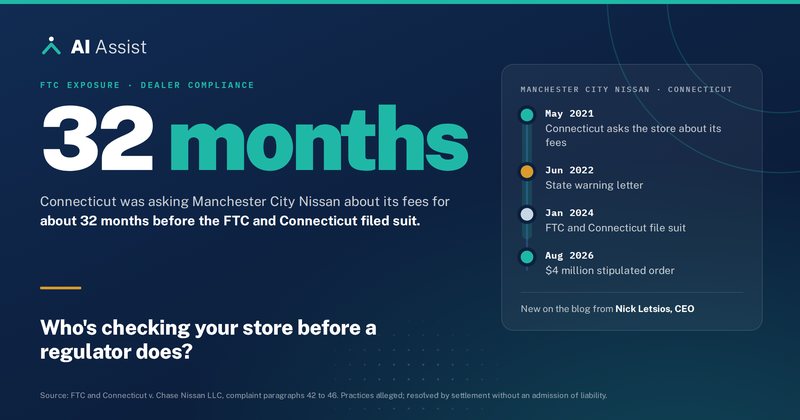
What a credible dealer compliance monitoring program needs, the risks of a homegrown one, and how outside and inside records work together.
Read the post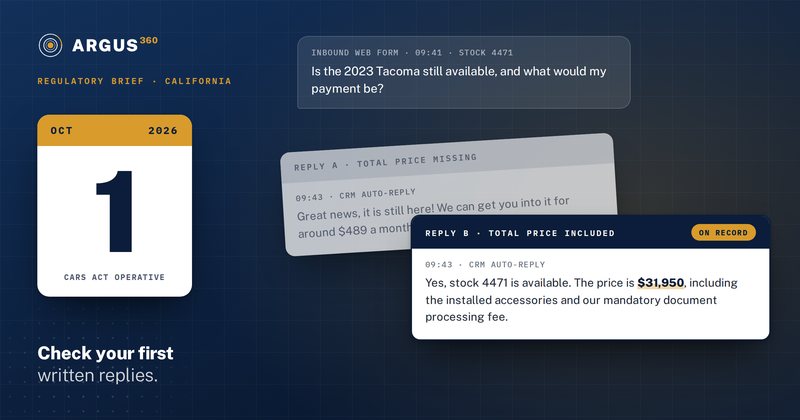
What California dealers need to check in their pricing, customer replies, add-on sales, and cancellation procedures before October 1.
Read on argus360.ai
Marina Letsios launched AI Assist, Inc. the day before California's SB 766 took effect, with an independent audit platform and an F&I platform as the first two products.
Read the press release