FTC Scrutiny Is Broadening. Who's Checking Your Store?
A CBT News conversation with the chairman of Maryland's dealer association makes the case for watching your own store before a regulator does. Here's what I'd want in place, why a homegrown program carries its own risks, and how we built AI Assist to help.
The October 5 CBT Live segment on dealer compliance is worth ten minutes of every dealer principal's week. Jaelyn Campbell of CBT News talked with Sam Weaver, VP and Partner at Chevy Chase Automotive and Chairman of the Maryland Automobile Dealers Association, and Vince Melkumyan, founder of Auto AI Radar, and they started from a point I agree with completely: pricing and advertising compliance has gotten too big to watch by hand.
I've spent more than thirty years in automotive retail, and Weaver summed up the problem better than most compliance memos I've read. He said dealers "may not know what they don't know," because the rules and the number of places a customer meets your store have both multiplied.1
01 · The ExposureYour price lives in more places than your website
Think about every place a customer saw a number from your store this week, including your website, your listings on third-party sites, the automatic reply your CRM sends to a web lead, a BDC text, and a salesperson's personal post about a lease special. The panel singled out employee posts, which can carry a payment without the disclosures that belong with it. Weaver also reminded dealers that outsourcing the advertising doesn't hand off responsibility for what the consumer sees.1
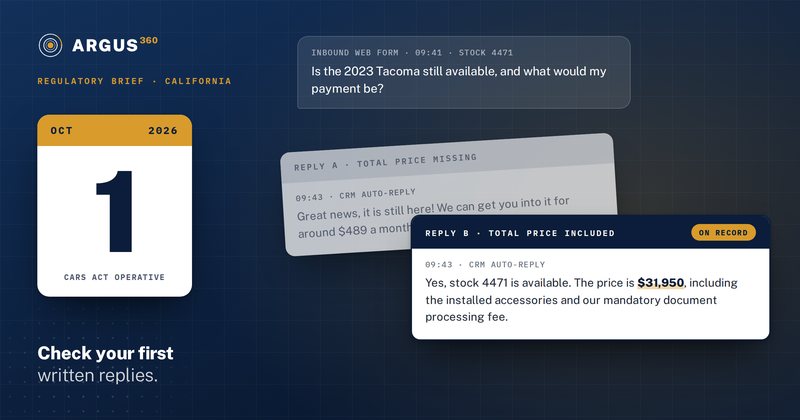
Regulators have been busy across all of it, starting with the FTC, which sent form warning letters on pricing to 97 dealer groups on March 13, 2026. The recipients' names became public on May 28. The letters carried no findings of wrongdoing, and they still showed the industry where the agency is looking.2 In April, Lindsay Automotive Group agreed to a proposed order that pays a $3.1 million civil penalty to Maryland and provides full refunds to eligible consumers, across transactions involving more than $75 million in charges.3 California's dealer-specific CARS Act, SB 766, took effect on October 1, 2026, and New York's broader FAIR Business Practices Act, which gives the Attorney General authority over unfair and abusive practices as well as deceptive ones, took effect on February 17.4,5
02 · The RecordNo prior enforcement doesn't mean no risk
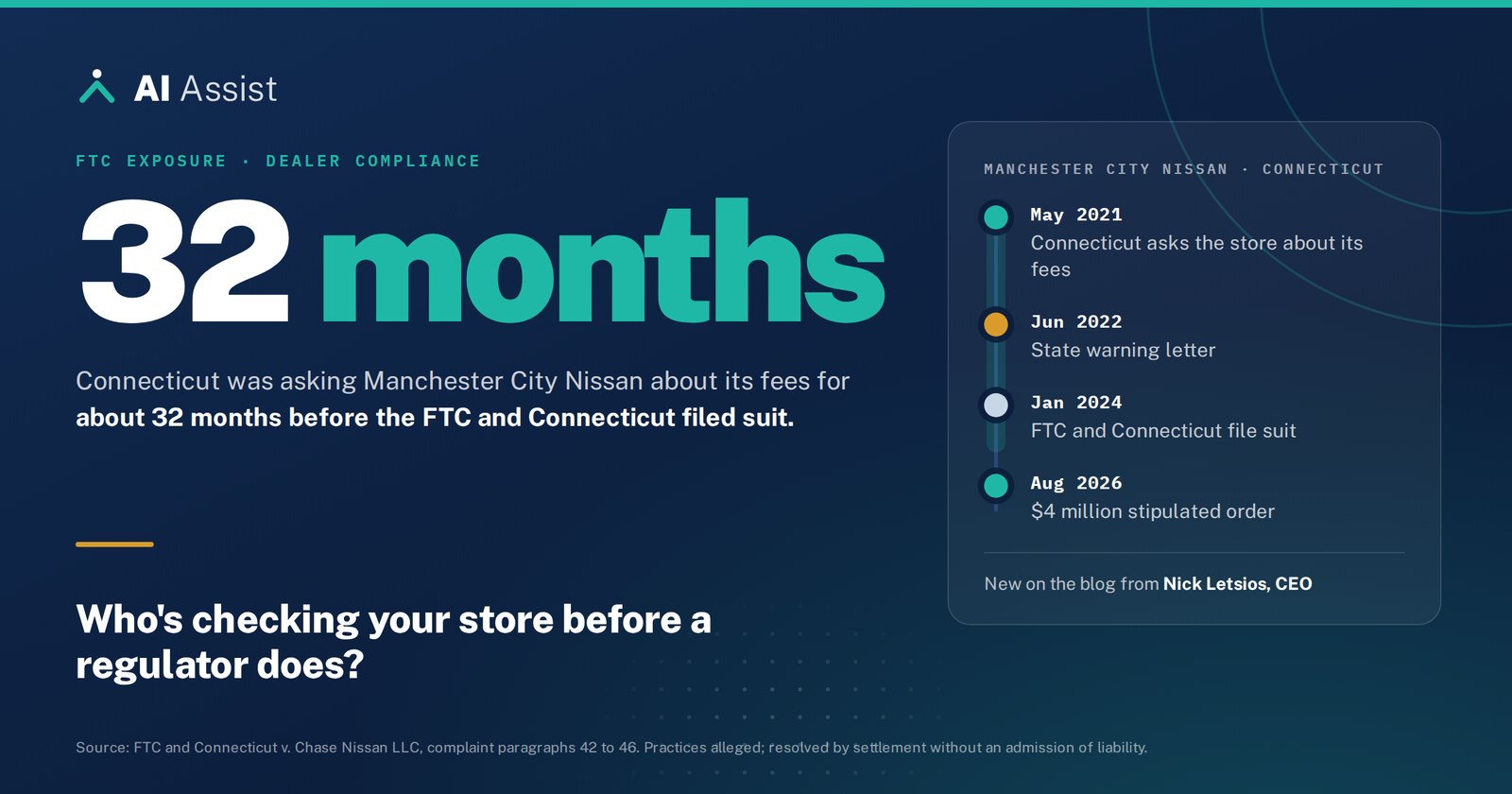
The panel's second point is the one I'd underline, that a clean enforcement history doesn't protect a store from future exposure, and Manchester City Nissan in Connecticut shows why. The State of Connecticut started asking the dealership about its fees in May 2021 and sent a warning letter in June 2022. The complaint alleges the practices continued after that. The FTC and Connecticut filed suit in January 2024, and in August 2026 the court signed a $4 million stipulated order providing consumer redress and limits on how the store sells, with owners and managers named alongside the company.6 According to the FTC and Connecticut, the dealership's own records showed the pattern.
Figure 1. The State of Connecticut was asking about these fees more than two and a half years before the FTC and Connecticut filed suit. The challenged practices are the agencies' allegations, and the matter was resolved by settlement without an admission of liability. Sources: FTC and Connecticut v. Chase Nissan LLC, complaint filed January 4, 2024, paragraphs 42 to 46; stipulated order, D. Conn., No. 3:24-cv-00012, signed August 2026; FTC press release, August 19, 2026.
A monthly outside review across that period could have created up to thirty-two dated checkpoints, giving management repeated chances to spot a recurring issue and correct it.
03 · The Build QuestionWhy a homegrown program puts the dealer at risk
Melkumyan's advice was to monitor proactively, so you can find problems, document when you corrected them, and show you're making a real effort.1 I agree, and plenty of good operators will want to build that program themselves. I respect that, since some of the sharpest people in this business build their own tools. For compliance monitoring, though, a homegrown program carries risks that usually stay hidden until someone outside the store asks to see the record.
The first risk is independence, because a check run by your own people, on your own schedule, about your own store reads like a self-report when it counts. Your people may be excellent, but anyone reviewing the record later will know they report to you.
The second is upkeep, since the rules keep moving. California's law took effect on October 1, and FTC staff published pricing FAQs for dealers in September, which are nonbinding staff views that still show how the agency reads price advertising.7 A homegrown checklist is only as current as the last person who updated it, and when that person changes jobs, the program tends to stop without anyone deciding to stop it.
The third risk is in the tool itself, since plenty of stores are wiring up AI models to check ads or read messages. If a homegrown tool stores, processes, or connects to the customer information a dealership collects when it arranges financing or leasing, it can become part of the system the FTC Safeguards Rule requires the store to protect, with the risk assessment, access controls, and monitoring that come with it.8 That's one more system to secure and keep current, and the dealer owns it.
Whoever does the checking, monitoring is only the first step. A program that holds up also needs documented escalation, correction, retesting, and closure, with counsel helping decide how findings are handled and kept, because a record of repeated problems that nobody fixed works against the store.
The build question
Two ways to monitor the same store
Built in-house
Third-party monitoring · Argus360
Who does the checking
Your staff or compliance lead, who know the store well and report to its management
Shoppers from outside the store, who see what a customer sees
Schedule
Can run on a set calendar, as long as staff time holds up
A set monthly shop cycle
Keeping the rules current
Your team and counsel track changes in each state you sell in
A maintained rule library covering 50 states and DC, with cited sources
What it can see
Internal records, deal jackets, and what happens in the F&I office
What a shopper can observe before the sale, which misses internal-only conduct
Data and security
The dealer secures any system that holds or connects to covered customer information
The dealer limits vendor access and reviews service-provider obligations where they apply
What makes it work
An owner, escalation, correction, and retesting
The same, since findings only help when someone acts on them
The strongest programs usually pair internal controls with outside testing. Neither one replaces counsel or management follow-through.
Figure 2. Operational considerations when weighing an in-house program against third-party monitoring. Sources: FTC, Automobile Dealers and the FTC's Safeguards Rule, frequently asked questions; Argus360 product scope.
04 · The AnswerHow we built AI Assist for this shift
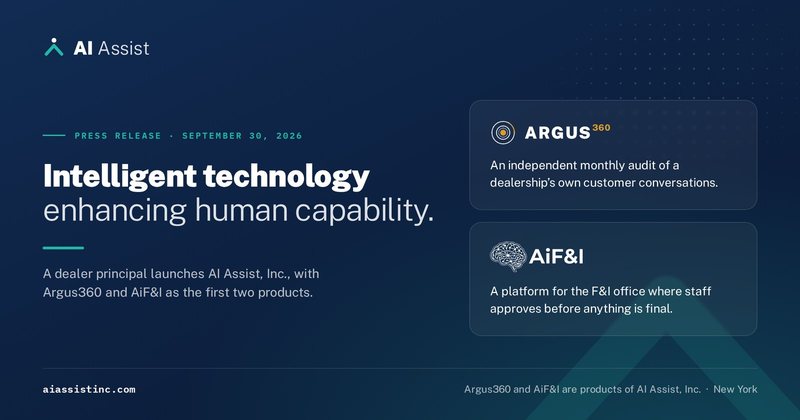
The panelists weren't talking about AI Assist and haven't endorsed it, though their conversation frames the problem our products are designed to address. Marina and I run a dealership today, and we built AI Assist around the problems we deal with ourselves, from the first reply a shopper gets to the last signature in the F&I office.
Argus360 shops your store from outside the way a customer would, by text, email, web form and, where call-recording consent rules allow it, by phone. Observed interactions are mapped to the statutes, regulations, orders, or staff guidance they're measured against, with the type of authority named, and the findings go to the dealer principal first, with the transcript and timestamp attached, for review with counsel. Each captured record receives a SHA-256 hash with timestamp, source, and access metadata, so a reviewer can confirm the stored file still matches its original capture. Argus360 is designed to go live in under six weeks, from contract to first Report Card. It's in beta at Atlantic Kia, the store Marina and I operate, with general availability anticipated in Q4 2026.
Melkumyan also expects scrutiny to reach F&I and fixed operations, and F&I is exactly why we're building AiF&I.1 It's designed to track the required disclosures within the deal workflow and log each step in the F&I office, with five agents doing the legwork and one rule over all of them: staff approves before anything is final. AiF&I is prototyped today, and our design partner program opens in December 2026.
Two records, one store
What the customer is told, and what happens at the desk
Outside the store · Argus360
What a shopper is told
Prices in your listings and on third-party sites
The first reply to a web form, text, or email lead
BDC follow-up, and phone where call-recording consent rules allow it
Findings tied to the cited rule or guidance, for review with counsel
In beta at Atlantic Kia. General availability anticipated Q4 2026.
Inside the store · AiF&I
What happens at the desk
Required disclosures tracked within the deal workflow
Every lender's status in one view, with staff choosing the lender
Deal steps logged as they happen
Staff approves before anything is final
Prototyped. Design partner program opens December 2026.
Together
Complementary records of the pre-sale customer experience and the F&I process, with findings routed for review, correction, and retesting.
Figure 3. Where each product sits. Argus360 documents what a customer is told before the sale, and AiF&I is designed to document what happens in the F&I office. They are store-level records and are not linked to the same transaction. Neither replaces counsel or the store's own controls.
05 · The CloseStart with what your customers saw this week
The panel's takeaway was to audit your digital presence now, websites and employee social media included, instead of waiting for a regulator or a customer to find the problem first.1 I'd add that whoever does the checking should make sure the record would make sense to someone who has never set foot in your store, because sooner or later someone like that is going to read it.
The best time to find a problem in your store is before anyone else is looking for it.
The point, in one sentence
AI Assist
See what your customers see.
Argus360 shops your store from outside and ties each finding to the rule or guidance it's measured against. AiF&I is designed to keep the record inside the F&I office, with staff approving every step.
Jaelyn Campbell, "Dealers face growing FTC exposure as compliance becomes more complex," CBT News, CBT Live, October 5, 2026. Panel remarks as summarized in the article. cbtnews.com
Federal Trade Commission, "FTC Warns 97 Auto Dealership Groups About Deceptive Pricing," March 13, 2026. ftc.gov. Recipient names reported by CBT News, May 29, 2026. cbtnews.com
Federal Trade Commission and Maryland Attorney General, Lindsay Automotive Group, April 2, 2026. ftc.gov
California Senate Bill 766, Combating Auto Retail Scams Act, signed October 6, 2025, in force October 1, 2026. leginfo.legislature.ca.gov
New York FAIR Business Practices Act, Chapter 708 of 2025, signed December 19, 2025, effective February 17, 2026. WilmerHale, "Governor Hochul Signs the New York FAIR Business Practices Act Into Law," January 5, 2026. wilmerhale.com
Federal Trade Commission and Connecticut Attorney General, Manchester City Nissan, August 19, 2026; stipulated order signed by Judge Vernon D. Oliver (D. Conn., No. 3:24-cv-00012, Dkt. 284); complaint filed January 4, 2024, paragraphs 42 to 46. ftc.gov · complaint
Federal Trade Commission staff, "Automobile Industry Pricing Transparency: FAQs," September 2026. Staff views, not binding on the Commission. ftc.gov
Federal Trade Commission, "Automobile Dealers and the FTC's Safeguards Rule: Frequently Asked Questions." ftc.gov
Argus360 and AiF&I are products of AI Assist, Inc. Argus360 findings are evidence for review and do not provide legal advice or a legal determination. Whether a specific advertisement, message, or practice meets a given rule is a question for your counsel. The Lindsay and Manchester City Nissan matters were resolved by settlement without an admission of liability.
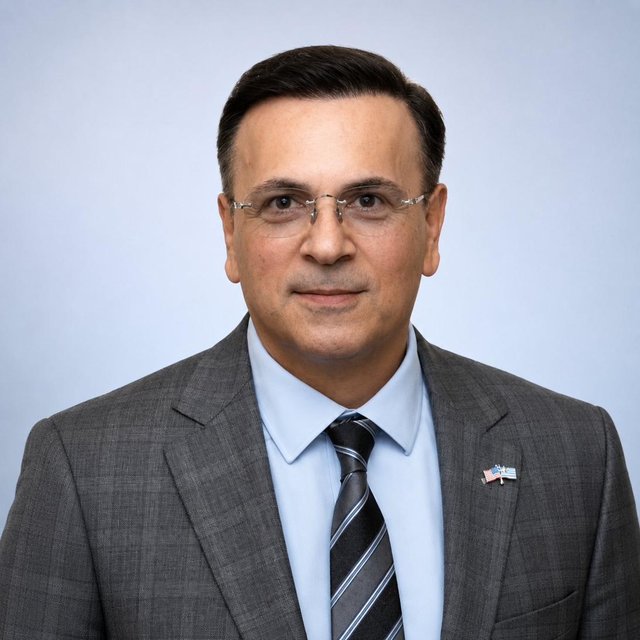
About the authorNick Letsios
Nick Letsios is CEO of AI Assist, Inc. He has more than thirty years in automotive retail and operates Atlantic Kia with Marina Letsios, the company's founder.